

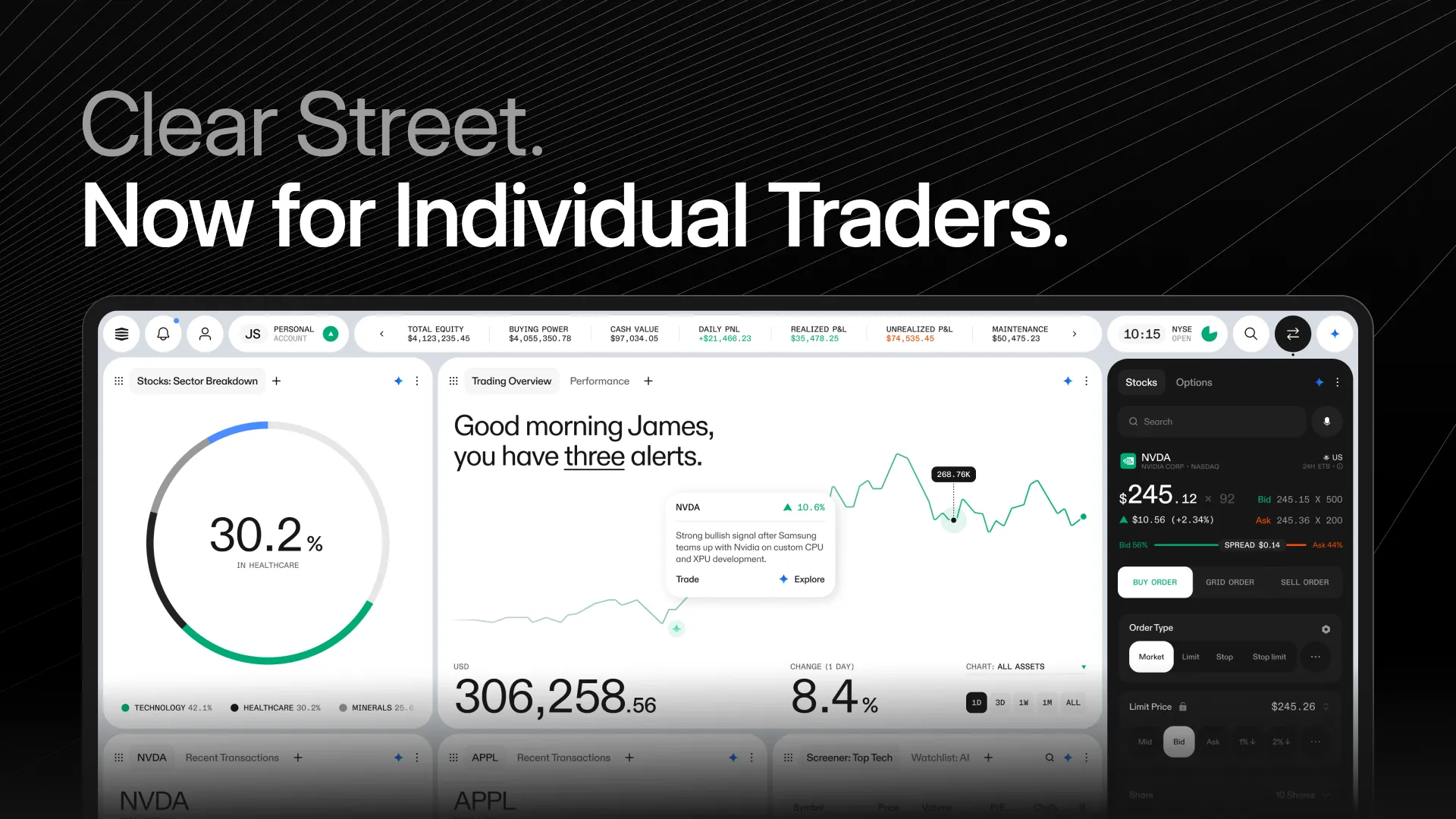
Market Infrastructure Needs More Than an Upgrade

Today's markets are more interconnected and complex than ever, and the systems supporting them are struggling to keep pace. The pressure isn't just from volume. It comes from rising investor expectations and the limitations of infrastructure that was never designed for this environment.
At Clear Street, we believe meeting that challenge requires more than incremental improvements. It means rethinking how execution, clearing, financing and risk work together on a single, real-time platform.
The Problem with Today's Infrastructure
Most brokerages still rely on fragmented systems built in isolation over decades. Execution, clearing, financing and risk sit on separate stacks. Traders and risk teams operate across disconnected tools with limited real-time visibility into positions, margin and exposure. In stable markets, that can be manageable. In volatile conditions, it creates friction and amplifies mistakes.
Clear Street is built differently. A cloud-native infrastructure layer underpins a unified real-time ledger and data platform, with applications developed on top. Instead of stitching together separate systems, the platform operates as one environment — spanning asset classes, markets and the full trade lifecycle.
Speed Means Nothing Without Control
Think of Clear Street's platform as a high-performance vehicle. The infrastructure is the engine — powering execution, clearing and financing. Risk management is the navigation system. The destination hasn't changed. What changes is how reliably and efficiently you get there.
That’s where real-time becomes foundational. Positions, margin, liquidity and exposure must be tracked continuously across every asset class and workflow. For institutional traders, that's the baseline expectation. It enables faster decisions and the ability to respond as conditions evolve — not after the fact.
When execution, clearing, financing and risk function as parts of one unified system rather than separate processes, the result is less operational friction, better capital efficiency and more precise decision-making when it matters most.
Where AI Fits In
Artificial intelligence is emerging as the sharpest tool in this integration — but only when applied by teams who understand the underlying mechanics. Clear Street uses AI in targeted, deliberate ways: automating margin functions, accelerating development and enabling workflows that proactively surface insights. Technology is applied where it improves outcomes, without introducing unnecessary complexity or risk.
Infrastructure as Competitive Advantage
This shift isn't limited to the largest institutions. Hedge funds, family offices and sophisticated investors now expect the same real-time insight and control that was once reserved for the biggest players. Meeting that expectation requires infrastructure built for today: cloud-based, API-driven and designed for continuous operation across asset classes and geographies.
Over the next five years, the impact will be clear. Traders won't just see their risk — they'll understand it as it evolves. Margin will adjust dynamically with positions and market conditions. And as more activity consolidates onto unified platforms, the system compounds: better netting, improved capital efficiency, sharper pricing.
Infrastructure stops being a constraint. It becomes a source of advantage.
Get in touch with our team
Contact usClear Street does not provide investment, legal, regulatory, tax, or compliance advice. Consult professionals in these fields to address your specific circumstances. These materials are: (i) solely an overview of Clear Street’s products and services; (ii) provided for informational purposes only; and (iii) subject to change without notice or obligation to replace any information contained therein. Products and services are offered by Clear Street LLC as a Broker Dealer member FINRA and SIPC and a Futures Commission Merchant registered with the CFTC and member of NFA. Additional information about Clear Street is available on FINRA BrokerCheck, including its Customer Relationship Summary and NFA BASIC | NFA (futures.org). Copyright © 2024 Clear Street LLC. All rights reserved. Clear Street and the Shield Logo are Registered Trademarks of Clear Street LLC